Coming soon: a new web address for this blog!

[[[At the end of November I'll be migrating this blog to a new address, which will be: racemehome.blogspot.com]]]
Showing posts with label Rwanda 2012. Show all posts

06 May 2013

the psychology of primate play

Last week I had to change my topic for a semester-long research project in my experimental psychology class. There are two weeks left in the semester. Awesome. (That's a sarcastic "awesome," by the way.)

The new topic is how play behaviors contribute to the lifespan development of primates, physically and socially. I'm lucky that I have data gathered from my trip to Rwanda last summer. Still, I'm a bit stressed right now. And I cannot wait until this semester is over.

~

Anyway, this is a cool topic. I'm pretty much in love with it. What is the purpose of play? Why do we do it? For fun! But why is it fun? Why does it have such universal appeal, and why do children play the same ways all over the world? We're learning that play actually does serve a developmental and evolutionary purpose. It isn't just fun. And that is really interesting.

Let's talk cognitive ecology. That's the study of how a species' cognitive patterns are shaped by the specific problems presented by its habitat. We must try to understand the problems presented in the species' habitat - what predators they have to evade, what dietary needs they have to meet, how their locomotion is determined by their physical environment  - and we must try to understand the solutions possible and the solutions utilized by the species. These points of study (which are only some examples of ecological problems faced by any given species) give us windows into the cognitive patterns of that species. If we can figure out why a species utilizes one solution over another for a specific problem, we begin to understand the cognitive patterns and priorities of that species.

So why study play? Play is a window to cognition, too. Studying cognition is never a direct process, even with human subjects. With non-human primates, or any animal, it's even more problematic. In a sense, we are reduced to using Skinner's Behavioralism in order to study the cognition of non-human primates. We can only observe behavior, we cannot ask them what they're thinking (generally speaking; Koko the gorilla doesn't count, in this case). Play is important for this, because - hypothetically - it patterns adult behavior and prepares immature animals to meet the challenges they will face as adults of their species. Now, if that hypothesis were accurate, then we could expect to see evidence of that.

...more to follow.


20 August 2012

in Rwanda: 29 July 2012, Bones sees bones


Journal 29 July 2012

Today was a whole lot of awesome, followed by a whole lot of work.

This morning we got to see the gorilla skeleton project in action. Shannon McFarland, a primary researcher on that project, gave us a presentation on what and how they’re doing, then we got to see the lab and the bones, and meet some of the other researchers. Pictures were taken. It was awesome. Then Chelsea and I (and the other teams) spent the rest of the day trying to perfect our own presentations. In fact, this journal is going to be quite short, because Chelsea and I still have presentation work to do. Tomorrow is the big day!


Shannon McFarland, showing us an unusually shaped gorilla skull:


Puck, may she rest in peace:


18 August 2012

In Rwanda: 24 July 2012, the gorilla slap

Journal 24 July 2012


Early mornings and fast hikes are worth it, when you’re rewarded with a two-hour gorilla play session on the side of an inactive volcano. That pretty much sums up my day yesterday.
~


What, you mean there’s more to this journal?

Ok, so here’s the details:

Chelsea, Amanda, Aya, and I were ready to go by 0600 this morning. Chelsea and I lucked out (in my opinion) and got picked to go to Titus’ group. Pretty exciting – even though Titus has passed on, he was something of a hero of mine, and getting to observe the group that is still named for him was pretty awesome. Theodette, one of the Karisoke research assistants, took us and Prof Dieter up to Titus’ group. It was a pretty fast hike up to the buffalo wall, which wore both Chelsea and I out, but seeing the gorillas breathed the life back into us. Theodette had to concentrate on doing her observations, but another tracker (whose name I can’t even begin to spell, unfortunately) spent the time with us and helped us to identify individuals. Most notably, we were able to watch two juveniles, named Fat (8 year old female) and Segasera (6 year old male; not sure I spelled that right, and he was called “Seg” for short). They spent around two hours playing, with a brief – maybe 20 minute – nap in the middle.

Their play vocalizations were practically constant. In other species, Chelsea and I have been noting vocalizations during play, and we really haven’t heard a whole lot. For gorillas, we had to scrap trying to count vocalizations because it never actually stopped. We would have had to count the entire session as one long vocalization, which doesn’t make sense. So instead, we noted the vocalizations as constant, and counted chest beats – another communicative noise – instead. And actually, “chest beats” is something of a misnomer because when it’s a play invitation, they beat the tops of their bellies, not their chests. We noticed Fat doing that, and asked the tracker if she did it that way because she was female (remembering that only males have the anatomy to really make that chest beat ‘pop’ sound). He said they all did it that way when it was a play chest beat. Sure enough, we later noticed Seg doing that, too. Thinking about how much they vocalize, and why that’s not the case with other species, went hand-in-hand with the realization that their play is almost entirely focused on social dominance. Along those two lines, I wondered if they were able to focus on their social relationships because they didn’t have to worry about learning to fight or evade predators; and if their prominent noise-making was also due to a lack of predators. Hmm.

Oh, and I got slapped by a gorilla. Seg. So did Chelsea. He was testing to see if we would play, too, I think.

Best Day Ever. (Yet.)


in Rwanda: 21 July 2012, to Dian Fossey's Grave

21 July 2012

If one picture is worth a thousand words...


17 August 2012

L is for learning, and Lorelei

[This is me catching up on my Pagan Blog Project posts.]


Recently, I posted about my visit to the Rwandan Genocide Memorial. At the memorial site, there was a museum which housed a brutally honest evaluation of the causes of the genocide - that was enlightening. It also housed a large section exploring several (though not all) genocide events throughout history, including the Holocaust.

While we were leaving, I heard this from one of the other students:

"I didn't go in the Holocaust section. My mom is Jewish, so she doesn't want me to read that stuff. It's too upsetting for her. Like, I'm not allowed to read Anne Frank's Diary, or anything like that."

I couldn't even process it at the time. That statement just had so many things wrong with it, and I was already so discouraged and numb from my tour of the grounds. The statement struck me, but I put it on a back burner, knowing there was nothing I could say to enlighten the other student, and so hoping I would forget it. I didn't forget it. It's lodged there, begging to be dissected. So here we are.

Willful ignorance. Surely that must be the most egregious of sins. Except maybe, passing that ignorance down to your children, that might be worse. Or as a young adult, choosing to acquiesce to your parent's demands that you remain ignorant.

And then I thought... what is it that makes ignorance attractive?
Why not  learn when given the opportunity?

It's not something I can grasp. Intentional ignorance is, essentially, intentional weakness. Who does  that?!

That student's mother, apparently. And, it seems to be heritable, like any other cultural disease. I have hope that someday, that student will be curious about the lessons history has to teach about humanity, and about her own family.

I don't know how useful this analogy will turn out to be, but I'm go with it anyway.

 I've read quite a bit about Lorelei since first hearing of her [from another blogger, cited below], but I keep going back to that first blog, and something she said: "So great is her beauty, and so sweet is her song, that sailors are distracted from their vigilance in the dangerous waters and are drowned." 

Ignorance, I think, is like Lorelei's song. It's sweet and beautiful to those who hear it, but it is embraced only at great risk, because it masks the dangers around us. It would be so easy to just shut out the things we don't want to hear, in favor of those that sound sweet to us. But reality isn't sweet, it's dangerous. When we close our eyes to those dangers, we risk our lives both literally and metaphorically. Beauty is only skin deep. At times, it hides greater beauty. But at times, it also hides a path to destruction. The key to knowing the difference, is learning.

Perhaps that's the attraction. Perhaps some people just choose ignorance because it's easier than facing reality. I will admit to having done that, at certain low points in my life.

I pray I don't pass that behavior to my child. I pray that I can hold myself to a higher standard.


~

Credit where due: I began my readings about Lorelei here, the blog of Laurelei Black, back in June. The quote is from that same blog post. She also linked to this site, which hosts a collection of Lorelei poems and lyrics.

~


In Rwanda: 19 July 2012, the drive to Ruhengeri


Journal 19 July 2012

Today was essentially one long car ride, from the west side of Nyungwe, back to Kitabi on the east side of Nyungwe, to Kigali, and finally to Ruhengeri, which is a city just south of Volcanoes National Park. On the bright side, we’re now a mere 45 paved minutes from the trailhead which we hope will lead us to the gorillas.

We’re staying at Centre Pastoral de Notre Dame de Fatima – a hotel that seems to be run by a church. Or perhaps it used to be part of the church, and is just capitalizing on the connection. I don’t know. The room Sara and I are in is pretty comfortable. Good hard beds, little balcony with a sling-back chair, and a glow-in-the-dark crucifix on the wall. It’s a little creepy, to be honest. That shade of green is very zombiesque.

We got a real treat for dinner: Volcana, a restaurant/bar that serves pizza. And not just any pizza. It was some of the best pizza I’ve ever had. Admittedly, not having had much in the past three weeks that wasn’t rice, frites, plantains, soup, omelets, or mystery meat, might have created a bias. It didn’t matter. The pizza was awesome, and it had pineapple on it, which is even awesomer. Don’t order the red wine though, that tasted remarkably like rubbing alcohol. Not awesome.

It was a long day of not much, and I’m totally exhausted. Time to get some serious sleep.


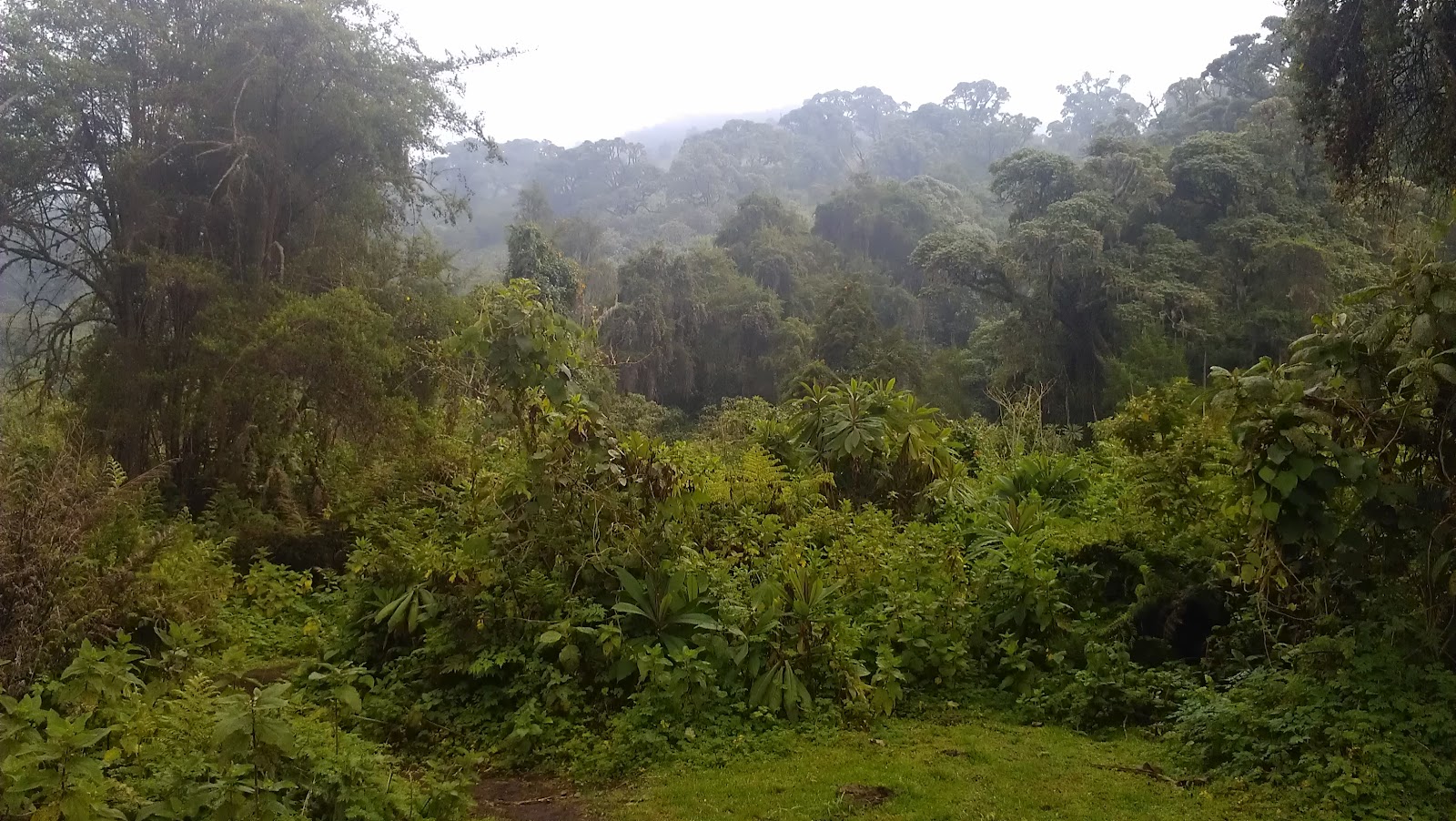
Gratuitous pictures of Nyungwe? Sure!


16 August 2012

In Rwanda: 15 July 2012, the Mangabey hike

Journal 15 July 2012

Woke up with a hangover today, and still no electricity in the house. My phone, which I’ve been using as my camera here, had no charge whatsoever. So no camera for me today. A few minutes later, a little alka-seltzer, some breakfast, and a hard-boiled egg, and I was almost functional. We tried to have breakfast a little early so we could be gone by 8am, but the kitchen didn’t have the eggs done until just about 8:00. So we wrapped them up with some sandwiches, and took them with us for lunch.

On the way to Uwinka, where we were going to try to see the Mangabes, we had a close encounter with a L’Hoesti Monkey. We had slowed down to pass a road construction crew, then stopped because the monkey was in the road, right next to the crew’s truck. When we stopped, the monkey jumped right up on the hood of our car, and leaned over to peer into the passenger side window. It’s probably lucky that the window wasn’t all the way only, just cracked a few inches. It jumped off after determining that we weren’t so interesting, after all. Prof Netzin got some pretty good pictures of it.

When we got to Uwinka, we learned that the trackers weren’t sure where the Mangabes were, so we would have to wait. Sara had come prepared though, with a Frisbee in her backpack. Several of us and a couple of the park rangers played Frisbee while we waited. The activity helped settle my stomach, which was pretty unhappy again after the hour-long car ride. Finally, the guides determined that the best course of action was to start hiking in the general direction of the mangabes, and take more specific direction from the trackers once they found them. So we started walking out of the entrance to the ranger station – and stopped there while our guide consulted with the trackers via radio. A few minutes later, we were back in the car, driving to a trail that would take us to the mangabes. Half hour ride, one hour hike, he said.

The car ride really was about half an hour. Two and half hours of hiking later, we found Grey-cheeked Mangabes. It was actually one of the best hikes I’ve ever been on, so I’m not complaining. We met up with one of the trackers (the other was staying with the mangabes), and followed him off the trail and through the rainforest. We were climbing at some points, sliding down at others, and even crossed a stream with a small waterfall right behind us. At one point, Sara and Prof Netzin made themselves crowns of ferns. Around the same time, Prof Netzin said she thought the mulch we were walking on at that point smelled like mushroom soup. We decided that it was the earthy, fungal smell she was noticing. Thus, she and Sara were dubbed the queens of the fungal in the jungle. It’s probably true that being ‘in the field’ does strange things to your mind.

We stopped to eat a very quick lunch on the side of one of the mountains we were traversing, then continued on. We were rewarded on a steep slope, where we could see across the canopy where the mangabes love to stay. They were resting, which was lucky because following them would have been a real bitch. They’re arboreal, and could have leaped through those canopy trees and right out of sight in a few moments, if they had wanted. We stayed and watched them for about an hour. I got a rough demographic – there weren’t that many individuals in sight, so it was pretty easy to get a count and an idea of age, but they were far enough away that it was very difficult to tell sex, even with the binoculars. We saw some grooming behavior, and some territorial communications, and thought we may have heard some agonism going on, but we couldn’t see that so it’s hard to say. It was time to head back too soon. We had only three hours to find our way back to the road, where our driver was waiting, before the park closed. The trackers took us back a different, shorter way, and left us with our guide once we got to an actual trail. The guide got us safely back to the car. On the way back, our guide pointed out a grandfather mahogany tree – that was the oldest mahogany tree in the park, and all the roots that were visible for 40 meters around us (and there, but out of sight beyond that) were from that tree. The tree’s offspring were growing around it and from its roots. Prof Netzin took my picture with the grandfather tree in the background. It was so awesome seeing all the mahogany trees in that forest. My father liked using mahogany for the furniture he built, and I had always wondered what one would look like in person. I had a feeling that pictures wouldn’t do it justice. I was right. They were majestic, and they all had an energy about them that was completely patient, especially the grandfather tree.

At one point on our hike, we noted that the vegetation here had very little thorns or other sharp pointies, while in Akagera it had seemed like everything had spikes. It made me wonder if there’s a similar sort of selection in plants as there is in animals. Meaning, perhaps the plants in Akagera – which is primarily woodland savanna – have to expend more energy protecting their somatic investment because there’s fewer of them (due to the ecology of that place) and it’s more difficult to survive to reproductive age there. While in the rainforest, even a mountain rainforest like Nyungwe, it’s very easy to reach reproductive age as a plant because the habitat is overflowing with specimens of each species. There’s less likelihood that one species will be targeted to extinction by another species (be that plant, animal, or whatever) because there’s just so much of everything. Or, because the climate makes it easy to grow and reproduce quickly. It seems plausible, but I feel like there’s some part of this equation that I’m missing, and that could change the entire hypothesis.

So I also used the time hiking to think about this baboon problem. It seems to me that any solution must approach this from two angles; it’s not enough to just change the current culture of the baboons, we must also figure out why they began coming into villages and raiding crops/trash in the first place. Did they venture out simply because the crops are easy to get to? Easier than what they were already eating? Was it simply part of their exploratory nature? Or, is the problem what one man suggested: there’s not enough food in the habitat for a too-large baboon population? Another man mentioned that they didn’t even know how many baboons there are in any of the Rwandan parks. Perhaps, the problem is that their ranges are too crowded, and they have expanded outward as a result. If that’s the case, perhaps some sort of population control would be beneficial? With that thought, the hunting seasons and licenses we have in the States for various game came to mind, but I suspect something like that might be more detrimental than beneficial. It could, potentially (in my mind), confer some sort of legitimacy to the already problematic poachers. So maybe chemical castration? I don’t know what other forms of population control might be viable. Honestly I really don’t know what other forms even exist.

So there I am. The problem as a whole has to be solved on two levels. Also, each park will require different solutions to their specific, immediate problem, which is changing the culture of their baboons. I think that in each of the parks, the culture change can be accomplished by a multifaceted approach. They will need to tailor a plan for each, because each plan must account for and address multiple aspects.

For example, in Akagera, there is no trouble with baboons leaving the park. So a buffer zone surrounding the park might not be immediately important. More important would be containing trash and securing buildings so that neither is accessible to baboons (perhaps they could get guidance on this from zoos?), and some sort of taste aversion that makes the food/trash unappealing to the baboons. Though taste aversion should probably be chronologically placed before containment. Later, a buffer zone should be considered because being denied the food they’re accustomed to around the lodge may encourage the baboons there to start going out of the park in search of food. It does seem possible that a lack of resources or space in the forest is what drove them into human areas in the first place – and there we are back at the source of the problem. One thing I’ve noticed here in Nyungwe, though, is that the baboons eat the grass around the tea plants, but not the tea plants themselves – could they be useful in that sense as “weeders” for crops? Obviously it would have to be crops the baboons won’t eat, like the tea plants. Other crops would have to be grown elsewhere, perhaps beyond the buffer zone. Perhaps that’s also a way to encourage a more positive perception of baboons by locals.

As some point in this reflection, I got distracted by the more immediate problem of getting a fellow student up the hill and back to the car, so my musings stopped there.
~
We got back to our car, and then back to our houses, just in time to get ready for dinner. We were all pretty excited when our electricity came back on just a few minutes after we got home. We turned the water heater on and started the shower roster for after dinner. A couple of us followed up the after-dinner showers with a movie (Old School). I even got a call to Archer in. All in all, it was a great day.


L'hoesti monkey


gray-cheeked mangabey


I can't take credit for these awesome photographs.
Grace took them with her awesome camera.

15 August 2012

In Rwanda: 14 July 2012, Oh Sparky, and the Singer

blog entry - 14 July 2012

Saturday. Woke up this morning and went to watch baboons before breakfast. There’s a troop that hangs out here in the park ranger housing area. So it wasn’t a far walk, just up the hill near the park HQ.

Last night I went to bed early – sometime before 10pm – and this morning I slept until at least 5am, I think. The Guinness I had with dinner helped. I haven’t eaten much for the past week – lack of appetite and all – and dinner wasn’t much better. Somewhat better, but not much. I was digging the cream of chicken soup all over my rice, though. I hope we have that again tonight.

Anyway, I didn’t check the time the first time I woke up, but it wasn’t totally dark so it must have been close to dawn. I did go back to sleep, and got up again at 6ish. I tried calling Archer almost immediately, because I missed him and hadn’t been able to reach him the night before. I needed my Archer fix. Something about just talking with him, about anything, always makes me feel better. Like my world is ok, after all. He gives me faith, and I was a little short on that last night and this morning.

I got his voicemail, and just hung up. I had nothing useful to say, and I knew he would see the missed call and call back if he could. Sure enough, he called back just as I was getting ready to walk out the door for our baboon observation. I walked slowly, behind the group, trying to prolong the time I had to talk with him, but I got to the baboons too soon, and I had to hang up. I hated doing it. We had been having one of those talks where we just go on every tangent that came up; it was a meandering, unworried conversation, and it made me happy. It ended too soon, but I held on to the good parts and had a pretty good day overall. I just feel like I don’t get enough. We always have to hang up too soon. Maybe that’s just going to happen whether we get “enough” time or not. (How much is enough? I don’t think anything will be enough until he’s holding me again.)
~

So, baboons. We saw the baboons. There were coming out of their sleeping trees as we walked up. We followed them up the hill to the HQ area. There’s also a power transformer near the HQ. It’s right across the road. There’s a fence around it, but there’s nothing over it, and the fence is nothing the baboons can’t climb. The adults and older juveniles were foraging, the younger juveniles were playing. I started focusing on three that were playing near the transformer. They were climbing the fence, and we were all concerned that they might get hurt. Sure enough, at exactly 0705, one of them touched the hot part of the transformer. There was a huge spark. It flew several feet over, and several more feet down, screaming all the way. Or maybe its playmates were screaming as they ran away. We documented the reaction of the troop, which was interesting, but I was also interested in the other peoples’ reactions. Sara and Prof Dieter both said it was dead immediately, without a lot of demonstrated emotion. A touch of sadness, an acknowledgement of the loss, but no grief. Almost everyone else expressed some degree of grief, as though they had lost a close friend or family member. And I wonder if those were the ones who haven’t experienced a lot of death. I wonder if experiencing death desensitizes us to it, as seems to be the case. Maybe I’m way off. Maybe some of us are just innately less sensitive. Maybe it’s some other reason entirely. Maybe they're just lucky.
We dubbed the dead infant "Sparky."
Oh, Sparky.

~

That afternoon, we visited the Kitabi Cultural Village. It's a replica of a traditional village and King's House ("Palace"). It's run as a cooperative (as most things in Rwanda are), and is set up as a way to show tourists some Rwandan culture and history, and generate income for the local village. It's brand new. In fact, we were the first visitors ever, and they weren't quite  set up yet. Still, it was a great experience. My personal favorite was the singer, who sung for us the way a singer might have entertained the King, traditionally. Maybe I'm just too irreverent for such things, but I found him hilarious.


14 August 2012

in Rwanda: 13 July 2012, 450 Colobus

blog entry - Friday 13 July 2012

Today is usually my lucky day. Not so sure this time around, but we’ll see. I’m still feeling a little nauseous this morning. It’s been ongoing for several days. Food hasn’t been very appealing to me. I’ve lost the huge appetite I had in the first week of this trip. Maybe that’s ok. I don’t know.

I had a weird dream last night. We all – the primatology students – went to Big Flats, which is the town I grew up in for the first ten years of my life. I pointed out where I used to live from a long ways away, then we were there. I couldn’t find my old house; it seemed that everything had been replaced by new development. Then, I saw our tree with the swing in the front yard, and our barn. The house was there in my peripheral vision, but I didn’t notice it. We went into the barn and all my dad’s things were there. It was much more than he ever had in reality. I spent the rest of the dream trying to haggle with the current residents over the cost of me buying some things from them. Of course that meant trying to pick just a few things that I wanted, when I really wanted all of it.

I wonder if I could go without my medication today. Maybe it would help my stomach. I think I at least have to take the malaria medication; maybe I should just skip the Aleve again, like yesterday. It could be just that I’ve been taking too much of that. I’ll see how I feel after breakfast.

~

Just took my shower. Realized that I’ve been feeling pretty uncomfortable in my clothes lately. I’ve been trying to just repress the feeling and ‘soldier on,’ but I think it’s catching up to me. Maybe I just need to adjust that. And take the anti-depressants.

~

Took two welbutrin and the malaria pill. Dressed in a way that made me comfortable emotionally. Well, as comfortable as I could be, with the limited wardrobe. Felt a little better today, just very low-energy and sad. I should do laundry before it becomes really important, but I just don’t want to. I might do a couple pairs of underwear before I go to bed tonight, but that’s probably my limit.

~

This morning did turn out lucky: we didn’t have to hike to see the Black & White Colobus Monkeys. There was a group close by that has ~450 individuals. That’s beyond huge. It’s the largest Colobus group in the world. The other group in the park has 15 or 16 individuals, by the way. We drove right up (on the road) into the middle of the Colobus group. Then we got out and wandered through, underneath the monkeys. They stay almost entirely in the trees, and usually pretty high up, so we didn’t disturb them. I think this group is relatively well habituated, too. I’m not sure, because I don’t know whether their familiarity is the result of intentional habituation by humans, or if they’re just not too worried naturally. Anyway, it was awesome. We stood there, completely surrounded by rainforest and monkeys, and just did behavior observations for about two hours. I got some good video and pictures. Happy morning.

[These are Black and White Colobus Monkeys.
Grace (fellow student) took this picture.]


[My camera obviously lacks the necessary zoom.
There's a couple Colobus up there grooming each other.]


[This doesn't get interesting until :29, and it's only :33 long, I think.
Still, it's a totally awesome leap made by a Colobus.
No biggie for him. He does it all the time.]


~

I like this blog. It keeps me honest. With myself.


13 August 2012

in Rwanda: 12 July 2012, we're just fucking dancing!

blog entry – Thursday 12 July 2012

I haven’t had time to write here. I mean, I’ve written a lot actually, but nothing for myself. I have written “journal” entries for the school portion of this adventure, but I haven’t been able to do any real reflection. I think that lack is contributing to my stress. And it makes me realize how fragile my mental stability is – if you can even call it that. There’s so much that I have to do, just to be myself. I have to write, I have to talk to Archer on a regular basis, and I have to take my medicine. Sometimes I have to take more medicine, for bad days. Surely it’s not normal to have to actively manage your activities, just to feel normal. I’m not even trying to feel happy. I just want to not be depressed and angry. I want to feel ok.

… Even just this paragraph helped. I’m starting to feel more myself. I only took two pills this morning… Two, which is my prescribed dose from the first doctor, but the psychiatrist said I need a higher dosage. It’s good that she said that, because I was already taking more. Today will be at least a three-pill day.

~

Three was enough. Actually, I don’t remember whether I took the third or not. Maybe two was enough. Either way, it was a better day for me. I’m feeling very down, but not angry. I think that the anger is symptomatic of depression, when I’m not paying attention and noticing that I’m down. Instead, I’m just reacting, and that comes out as anger and frustration. Now that I realize what’s going on with me – that I’m depressed – I’m just sad. I’m not angry. It’s easier to be compassionate, when I know that my problem is my own. I’m working on changing my perspective, too. Like Maya’s “kid” thing – where she calls everyone kid – which completely annoys me, and made me angry because it’s so disrespectful, from my perspective. But, I’m seeing it now (right or wrong) as her way of including everybody around her, a way of internally categorizing everyone as being the same as her in a way that makes her feel like she’s surrounded by like-minded people. I think it’s a comfort thing, for her. When I look at it that way, I can forgive the disrespect as unintended. It still annoys me, but I can get over it without becoming angry with her. She really doesn't deserve my anger.

I spent a lot of time in introspective thought today, despite the group activity this afternoon. We went for the canopy walk, which took us above the canopy of the rainforest. It was a hike down and back up, with a foot-wide suspension bridge across part of the rainforest. The bridge was 70 meters from the forest floor, at its highest point. Rationally, I was fine with that. I knew the bridge was safe. Physically, I had a major stress reaction. My limbic system didn’t believe all that “safe” hype. Even though my thoughts were calm, I was terrified. I kept a tightly disciplined focus on the backpack of the person in front of me. I couldn’t look down, couldn’t even look to the side for the picture Prof Netzin wanted to take. She did take it eventually, with me still looking forward, at the backpack. But I made it. One unseen foot in front of the other.

I never used to be afraid of heights. Maybe it’s because my balance isn’t so great these days. Maybe it’s just a physiological understanding of my decreasing bounciness as I age. Maybe I’ve heard too many horror stories of people falling or getting injured other ways, from heights. Maybe it's connected to the intermittent ringing in my ears and the dizziness spells (inner ear issues, I assume). I don’t know. Nothing traumatic happened. I’m just afraid of heights now.

[The Canopy Walk Bridge]


That’s all a tangent. The important part is figuring out the best way to manage my depression for the next two weeks. I think when I get home, I’m going to spend a very long time just curled up in Archer’s arms.

~

I want to go dancing with Archer. I want to feel him move against me and with me; I want that perfect body close, so close I can feel his heartbeat on my skin.

He’s going to ask me what brought that on, of course.

Tonight we met (as a group, with the Professors) with students from a wildlife management college here at Nyungwe. We had a pretty good discussion about the baboon problem being faced by the three national parks in Rwanda. After that, the Rwandans suggested some music and dancing. They put on some “Rwandan hip hop” (which included your standard American club music fare), and just about everybody got up and danced. There were a few wall flowers – in a group of nerds, that’s expected, and I was impressed that there weren’t more… maybe it’s because we’re primatology nerds. Anyway, it was fun. I danced a little, and the Rwandans – which were mostly guys – danced a lot. The quote of the night, “we’re not gay; we’re just fucking dancing!” Now imagine that as a yell, with a Rwandan accent. Hilarious, and awesome. One of the guys wanted to dance with me, and I did a little, but it mostly just made me miss Archer more. And we don’t really dance together. In fact, I barely dance at all anymore. I miss it. And I want to dance with him. So that’s where that came from.  


~

[Nyungwe National Park]


12 August 2012

in Rwanda: 11 July 2012, to Nyungwe


Journal, Day 11 [written on the 12th]

Yesterday, the 11th, was a rough day for me. There was a lot of up-and-down in my mood, which is only partially regulated by my anti-depressant medication. The morning started out well. It was our first night of not camping in a week, so I thoroughly enjoyed being in a bed, and having a pillow (I forgot to bring one with me on this trip). Sara and I had breakfast at the hotel – which was awesomely not camp food – and then walked around Kigali a bit to do some shopping. We got some more minutes for our phones, and stopped by a clothing shop that we had visited the night before. The two girls who work there, Fiona and Zya, remembered us from the night before (we had stopped there, looking for pants for Sara) and invited us to go to a club with them on Friday. Of course, we won’t be there on Friday – we’ll still be in Nyungway – so we had a good excuse to decline the offer.

I had some time in the morning, while we were waiting to find out the schedule for the day, to write a substantial email to Archer. That was a good feeling; it had been a while. I even had to write a note to my girlfriend, and some of my other friends. – And then the computer’s power went out. So I went and waited with everyone else.

We got a new driver and a new truck right around lunch time. That was great because the old driver was actually frightening (in his driving ‘technique’), we couldn’t communicate with him because he only spoke ikinyarwandan (which I probably just spelled wrong), and the vehicle was crap. The new driver speaks French and English, is a very good driver, and has a really nice – if a bit small – truck. We’re pretty cramped in there, but at least it’s safer and we can communicate with the driver. Unfortunately, I think the seating arrangement made me nauseous. There’s one row of regular seating behind the front seat, then the back of the truck has two rows which face the center of the truck. Sitting on one of the back seats means you’re moving sideways when the truck drives forward. I sat on the inner edge of one of those seats, and had a little less than half a cheek actually on the seat for the entire trip. The other girls helped out by putting bags and jackets next to the seat, so I had something to sit on, but I’m pretty sure I wouldn’t have been able to handle that without all the Aleve I took. My back is still paying for it today. It’s all good though. Next time, I’ll ask to sit facing forward. The nausea was worse than the pain, anyway.

The highlight of the day, and really of the trip if you exclude the research from consideration, was the dancers we saw at the museum yesterday. They wove dramatic dancing in with the traditional Rwandan dances, and drummed as they danced. There’s something very primal about drumming that moves me every single time. And their drumming was powerful. It really was an unexpectedly spiritual experience. On one hand, I wished I had my drum with me, because I was inspired by their drumming. On the other hand, I’m glad I didn’t, because not having my drum forced the experience to remain separate from anything I would do on my own. I’m not sure if that makes as much sense ‘out loud’ as it does in my head, but there you go.

After the museum we stopped for dinner at a nearby restaurant. The social aspect of that was fun, but it seemed to take forever to be served our food. Maybe it just seemed that way because I was so tired and nauseous. Then we were back in the truck, headed to Nyungway. Luckily, that was a shorter trip, and the car sickness wasn’t quite as rough. Somehow I ended up sitting entirely on the bags, though, with just a small portion of my thigh touching the seat. …I can’t do that again. By the time we got to the guest house, I was hurting, sick, and feeling very anti-social. Not a great combination when I’m surrounded by exuberant girls who were just excited to be here, and also probably tired. In particular, Lana and I really got on each other’s nerves last night, and it’s embarrassing to acknowledge that I snapped at her. We both had valid arguments, but neither of us recognized that until later. I was in pretty bad shape by then, and failed to control my temper. After things quieted down (mostly thanks to Bernd’s intervention), I took some time and just sat outside by myself. Sara sat with me for a little while, and graciously let me vent, but it got too cold for her after a bit, and she went inside. I needed the alone time more than I needed warmth, so I stayed out there and tried to calm down. Eventually, I went in and apologized to Lana. I wasn’t really calm yet, but I felt it was important to apologize before everyone else went to sleep. I’m glad that I did, but even this morning – the day after all this happened – I still don’t feel ready to be social. There are not a lot of options here, though, so I’m glad that at least today isn’t a heavily scheduled day, and I can relax, write, and reflect. It’s good medicine.

I probably spelled Nyungway wrong too. But you know what I mean, eh?

11 August 2012

in Rwanda: 9 July 2012, breakfast oracle

Taken 3 Aleve per day since the second day in Akagera. It’s 0612 right now. I’ve been awake for about an hour. I’m a little grumpy. No Aleve yet this morning. Have to wait until I eat. And I gotta try to eat more protein today. Wasn’t much in the last two meals. I want some more of that goat meat. Yum. Stays with ya. Like, in your teeth. Tasty though.


Ah, the silverback has emerged. (Good morning Professor Steklis, adult male.) Oh the coffee’s being poured through the strainer. Also yum.

There was a period of time this morning, say 0510-0520ish, during which everything was silent. There was no noise. No birds, no insects, no nothing. It might have been the end of the world. Sara’s pretty sure it was. I think if it were, that would have meant that I slept through Armageddon. Very plausible.

No really.

Definitely going to be time for some Aleve soon. Com’ooooooooooooooooon breakfast! Any time now, really. I wonder if I use that word too much. Maybe. Or maybe it’s a coincidence that it just happened twice in two sentences. Well, two fragments, anyway. Whatever. Man if only I could just type all day while we were doing stuff, I could actually capture everything that’s happening. That would be cool. My fingers would get a workout. I’d probably drop the laptop a few times. Maybe that’s not a good idea. Still, it would be cool if it were possible. Just because it would be cool to be able to capture everything. I know there are things I forget, even when I take notes all day.

Ok, still waiting for breakfast. Time for the cards. Or I’ll get caught up in daily activities and never get around to the cards.

Fire Dragon
Cow
Raven

A lot of raw energy, maybe aggression, is brewing and needs to be controlled. It could also be the vital energy of youth, which is destructive when misguided. It needs to be harnessed, not allowed to become destructive. That’s the causal dynamic. The social manifestation is feminine energy that should be used for nurturing, but maybe is being squandered. The resulting manifestation, which will be positive if the fire dragon is harnessed and the cow is allowed to nurture, is a great lesson in learning, in social accountability and the language of the group. If this is a negative lesson, the Raven is a prophet of the destruction which comes before new life. (Based on the preceding cards, I’d say that this isn’t a good time for destructive cycles – take that as a warning.)

Hmm. And with that, I’m getting dressed. All the tent-mates are awake now, so I won’t disturb anyone by doing so. And breakfast still isn’t ready. Perfect timing.


Today is my mother's birthday. She's 59. Shhhhh! Don't tell her I told!
I borrowed phone minutes from Sara so I could call Mom.
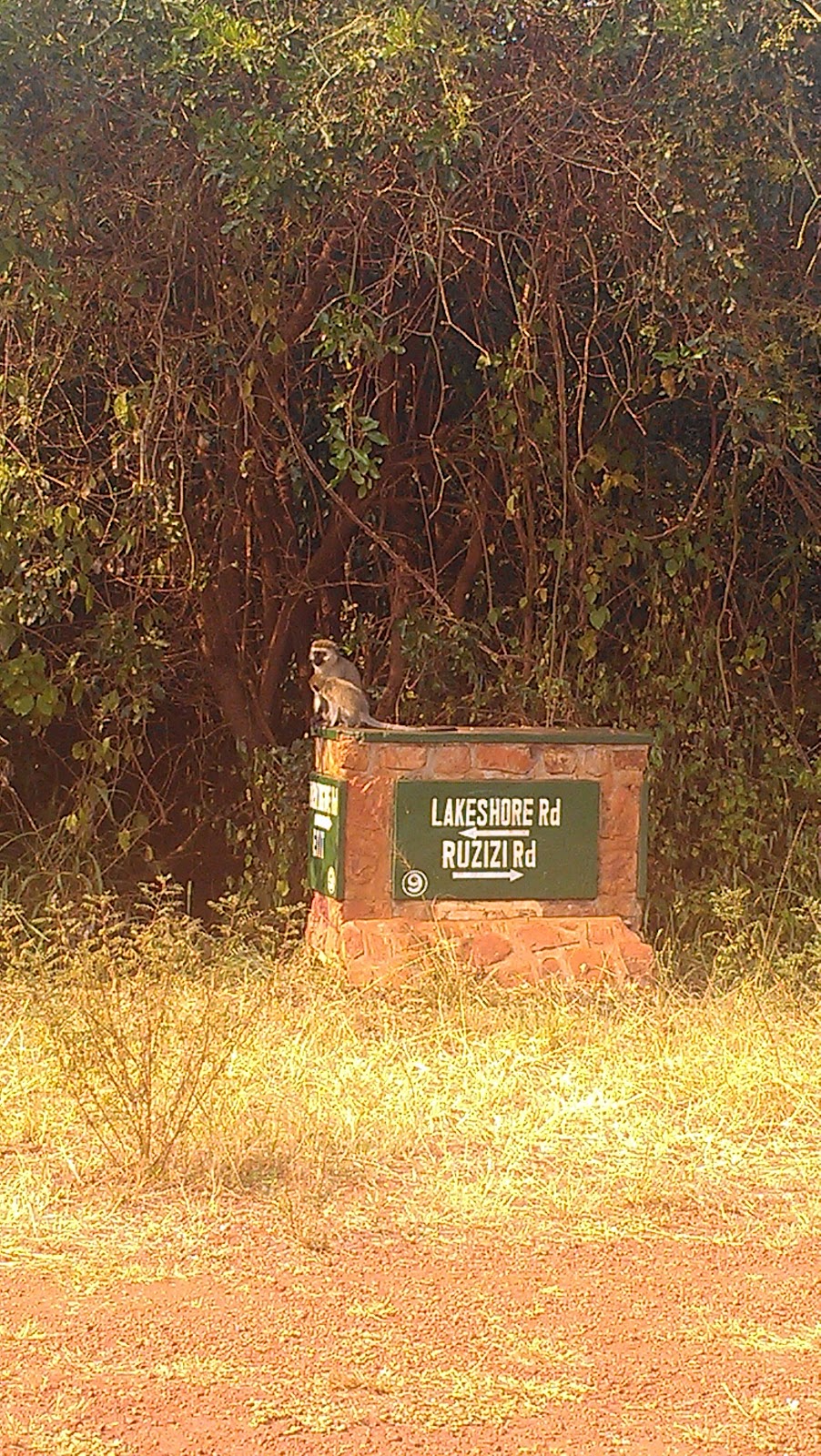
Gratutious Vervet Play!

10 August 2012

in Rwanda: 7 July 2012, beers at the lodge


Journal 7 July 2012

Last night we shared our campsite with a family with members from Spain, England, and Denmark. We’re calling them “the Norwegians.” No explanation for that one. It was Bernd’s idea.

We woke up early for a game drive today, and ironically saw less game than we have been seeing on our daily primate searches. We did see some topi, baboons, hornbills, zebra, and black & white turacos (which might have another name, Prof Netzin couldn’t remember, and none of the rest of us knew). What really stood out, though, was how obviously unqualified our driver is for game drives. He’s a city driver, and hauls some serious ass literally everywhere. It’s great if you’re in a hurry. Not so great if you actually want to see what it is you’re driving by. Even less convenient when you don't have a common language between you and the driver. Word of the day: "STOP!"

And, I’ve decided that the second-to-last row of seats in the bus is the worst. It’s right over the rear axle, so the bumps are most dramatic there, and the seat itself isn’t actually big enough for two butts. I was sitting on the outside, so I was higher on one side than the other, because of the bar on the outside of the seat cushion.

We were back in camp for breakfast by 0745, and I took three Aleve.

At 0850, we left camp again and drove to Percherie (the fishing village). In route, we saw some baboons traveling. I wondered what lives in the two huge holes in that road between our camp and the reception building.

At 0915 we stopped to watch some Vervets. I counted four adults, of which at least two were males and at least one was a female. I didn’t catch the fourth one’s sex. There were three juveniles with them. They were pretty far back in the trees, and I discovered that the easiest way to find them was to look for twitching tree branches. They’re very well camouflaged, despite their striking face-ruffs.

We watched them for a bit, and reached Pecherie at 0948. There we found a lone baboon male, sitting on a rock on the east side of the village. About 30 meters from the same rock, two vervets were walking on the far side of the village. We decided to call the lone male baboon “Somatic Man” because he seems to be investing energy in somatic growth (as opposed to reproductive growth). He was just hanging out eating fish, and completely relaxed there. In the future, this time spent alone with the protein-rich diet might mean he is stronger than some other males he might need to compete with. Could be a good investment. We watched him for a bit and talked more about his ‘choice’ of energy investment. He was just resting though, so it wasn’t a great opportunity for a behavioral profile ("Resting... resting... still resting...").


[This is actually a picture of him on a different day.]


Wandering around and through Pecherie, we did find a baboon troop and a few vervets to observe. We did behavioral profiles on them, and it was interesting to me to see how each student came to an understanding of profiling differently. For some it was difficult to refrain from anthropomorphizing the animals, and I’m pretty sure some still do. It’s certainly an easy trap to fall into.


[Vervet!]


While we wandered, we saw a couple of hippos in the boggy area on the shoreline of the lake. Prof Dieter walked closer to see if those were, indeed, hippos. He made a hasty retreat to the bus (where we were all waiting) when the hippos jumped up and maneuvered farther into the lake.

On our way back to the campsite, we saw more wildlife than we had seen when we were intentionally looking for them earlier in the morning. Between 1130 and 1200, we saw three more hippos, two bushbucks, two small herds of impala, two "cliff springers," and three zebras. After lunch, we went to the lodge and swam in the pool there. Well, some of us swam and played pool frisbee. Some of us sunbathed. Either way, it was fun, and a good break from primate demographics and behavioral profiles. We stayed at the pool until 1600, and had some great conversations. Our driver was late coming back for us, so we walked over to HQ, where our electronics were charging, and met the camp’s tame-ish duiker on the way. We were all afraid of scaring it off when we saw it, so we just stood still and watched it, but it came right up to us, completely nonchalant, and checked each of us for treats. When it discovered that we didn’t have treats for it, it just calmly walked away. We realized then that “it” was a female. Nobody knew the duiker’s story, but it must have one, to be so tame. They’re normally extremely shy. [We later learned that it had been orphaned by poachers and raised at the camp... or something like that. My memory's spotty on that one. When it grew up, it just hung around.]

We killed some more time, waiting for our driver, by wandering around the grounds looking for baboons. But, we didn’t get far before we were warned not to stray far – there were buffalo in the area, which can be very aggressive, so it’s dangerous to be wandering around out there, especially in the evening and at night, when the buffalo are more active. So we hung out in the soccer field for a bit and did a GPS/GIS lesson and talked about geocaching. After a while our conversation strayed from the relevant and into our personal interests. You can only talk shop for so long, in a soccer field.

I have to say, that when somebody asked the professors’ ages – which was pertinent to whatever conversation we were having – I was surprised by the rudeness of the question, but the answers made me happy. Here’s why: the difference in their ages is very close to the difference between my age and Archer’s age. Sometimes I wonder about the trouble which might be caused by that difference (24 years), and I think he does too. So it was heartening to see two people who have a similar age difference in their relationship, and who are obviously still very much in love after 20+ years of being together.

It started getting dark around 1800, so we decided standing around in an empty soccer field might not be the best idea (buffalo, remember?). We had a race to the lodge, which Bernd won with Sara close behind. There, we had some drinks and frites and talked about our theme team ideas. For cognitive ecology (Chelsea’s and my topic), we discussed how the socio-ecology of a species determines individualism versus collectivism. It’s particularly interesting to me, because I’d like to figure out how all that interacts with an individual’s sense of Self – Theory of Mind stuff.

When we got our drinks, I was hit with the realization that I never hang out with civilians. It was a weird moment, brought on by a toast. In our group of eleven people, I was the only one who touched the glass to the table before taking a drink. In the military culture (yep, I’m calling it that), as I have experienced it, you never do a toast or any ‘cheers’ and immediately take a drink. You always touch the glass back to the table or bar before drinking. When not in mixed company, you might even hear a service member say, as they touch the glass down, “and one for the fallen.” That touch is an acknowledgement of all those who have fallen, and can’t be there for that drink. Those who will never have another drink. I’ve been surrounded by military for so long, even before I joined, that I had forgotten there are people who don’t do that. It was a sad, weird moment for me. I was glad it was the end of the day, and I could be alone, at least in my sleeping bag, soon after.


in Rwanda: 6 July 2012, camp lunch

Lunchtime, 6 July 2012.

I’m going to be so busy transcribing all my notes into blog posts when I get home. It’s going to be ridiculous. Right now I’m focusing on getting my phone charged, so I can use the camera. I think I may need to remove the battery at night, so it doesn’t die once it’s charged. I had a little better than half the battery when I turned it off yesterday. This morning, when I turned it back on, the battery was so low that it automatically shut itself back off. It must be draining overnight, even though it’s turned off.

Lunch was goat ribs, Spanish rice, mushroom soup, mangoes, pineapple, oranges, beans, and fried potatoes. I don’t eat this well at home. It’s delicious and healthy. Craziness. I’ll be happy when there’s something cold besides water to drink. Oh, and bananas. Getting a little tired of bananas.

There was a hornbill (think Zazu, from the Lion King) in the tree behind us while we ate, but I missed it. Sara and Prof Netzin saw it. Another nearby tree has weaverbird nests. There’s three warthogs (maybe a mother and two offspring, since one is larger than the other two) which we’ve seen both mornings as we left camp, on the road between camp and reception. Later this afternoon, we’re going to see more baboons, we hope. If we can find them. Shouldn’t be too hard though; the troops around here seem fairly predictable, according to the workers here. For now, we’re going to set up the camp shower, and then we’ll have a little presentation on demography and recognizing individuals. Baboons are after that.

Recognition of individuals, and how many individuals members of a species one individual can recall, is a seriously interesting aspect of cognitive ecology. Prof Dieter is saying that humans can recognize and recall about 500 other individuals, and that correlates with the size of most tribes, historically (about 500 people). I wonder how much detail that particular type of recognition entails? Does it vary by gender, on either end? What about by sex?

Speaking of Prof Dieter, he found a baboon skull yesterday:

Freakin awesome.